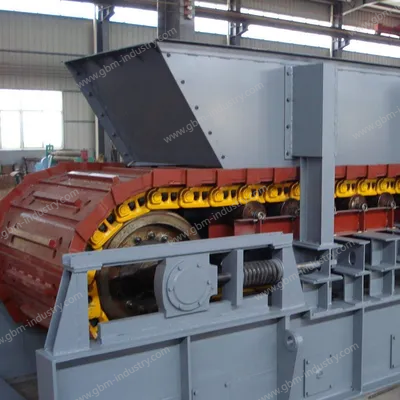


The calcium carbide crushing process involves transporting calcium carbide to the crusher using forklifts for fragmentation. Prior to crushing, large calcium carbide chunks are first broken down by impact (a process termed impact crushing). Calcium carbide dust generated during unloading, impact crushing, and transportation may partially escape. Due to the non-fixed location of unloading operations, managing dust generated during this process has long been an industry challenge. Employing heavy-duty belt conveyors in the calcium carbide unloading and crushing system allows direct unloading onto the conveyor, eliminating the need for forklift transport and breaking. This fixed unloading position facilitates the installation of dust collection equipment, enabling localized dust control. Eliminating forklift transport of calcium carbide reduces forklift operating costs.
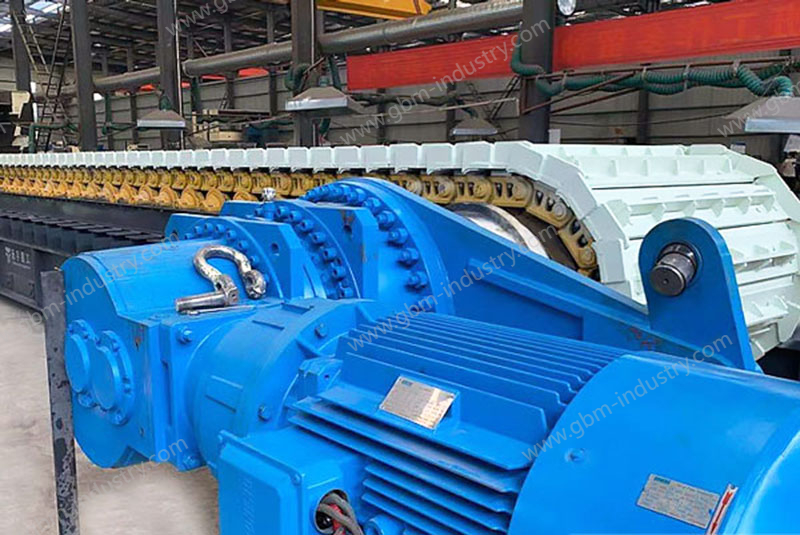
Structure of the Heavy-Duty Plate Conveyor
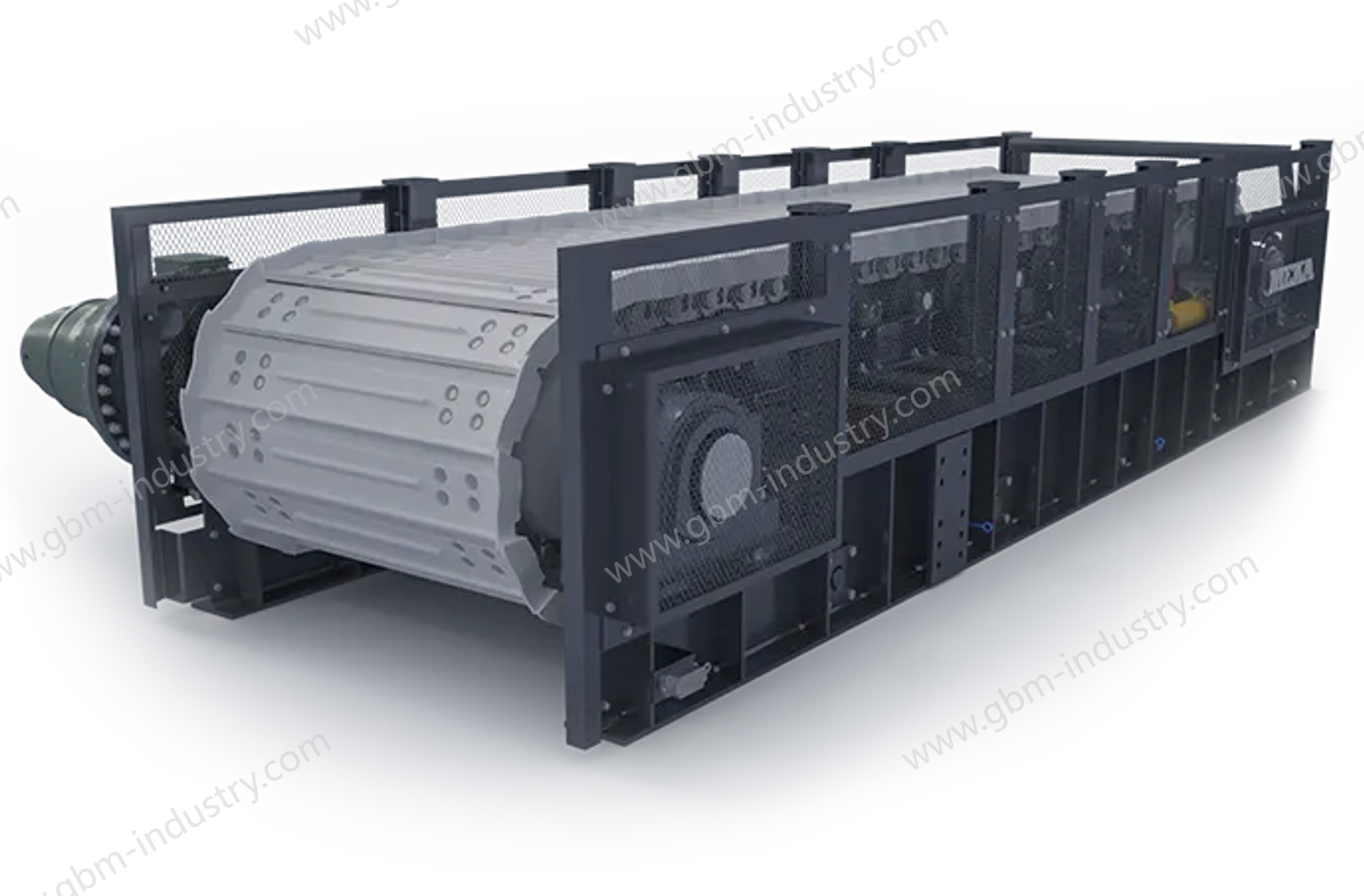
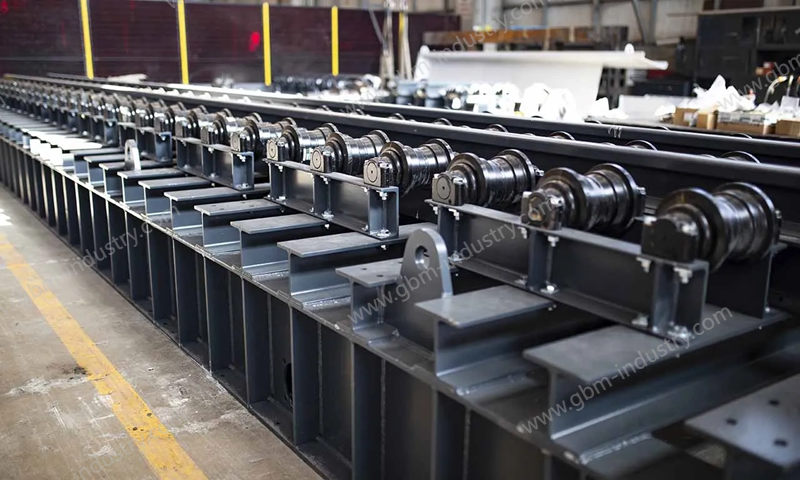
The heavy-duty plate conveyor consists of a drive motor, reducer, coupling, support wheels, chain plates, chain idlers, chain, tail wheel assembly, and support frame. The drive motor, reducer, and coupling form the power unit,providing the necessary power for operation. Support rollers mounted on the upper part of the support frame bear the chain plates while reducing operational resistance. Chain plates attached to the chain withstand the immense impact force of falling calcium carbide and propel it forward, serving as the transport medium. These plates are typically fabricated from thick, high-impact-resistant materials. The chain connects the plates and drives their forward movement. Chains are usually fabricated from high-strength steel, demanding superior wear resistance and compressive strength. The operational stability of chains and chain plates is a critical factor determining the reliability of heavy-duty plate conveyors. Chain idlers are mounted at the lower section of the support frame, providing support for returning chain plates. The tail wheel assembly is installed at the rear end of the support frame, supplying tension to both chain plates and chains. The tensioning device adjusts the chain’s tightness, ensuring more stable equipment operation and preventing chain plate deviation or derailment.
Application of Heavy-Duty Plate Conveyors
Heavy-duty plate conveyors are typically positioned at the very front end—the unloading section—of calcium carbide unloading and crushing systems. They receive calcium carbide unloaded from transport vehicles and convey it to primary crushers. The conveyor may be installed horizontally or at an incline, with a maximum angle not exceeding 20°. Conveyors exceeding a 20° incline risk causing calcium carbide to roll backward during transport, disrupting uniform feeding. Severe cases may block the crusher inlet or jam the crusher, impairing crushing efficiency and necessitating unnecessary cleanup.
Heavy-duty belt conveyors at the calcium carbide unloading end can be installed in two ways: 1) at ground level or below ground level, utilizing the height difference between the truck bed and the conveyor to break the calcium carbide during unloading, thereby reducing the operational pressure on the primary crusher. However, this installation method has significant drawbacks. Due to the large size of the primary crusher, its feed inlet is often above ground level. This necessitates a steep conveyor incline, which increases the risk of calcium carbide rolling backward and causing material buildup. Additionally, the high-impact drop during unloading stresses the conveyor and compromises operational stability. 2. Elevated installation above ground level minimizes the height difference between the truck bed and the heavy-duty belt conveyor. This method eliminates the need for a steep incline, reducing the likelihood of material buildup. The impact force on the conveyor is also reduced, promoting long-term stable operation. However, when large pieces or even entire blocks of calcium carbide enter the primary crusher via the conveyor, it places significant demands on the crusher’s capacity.
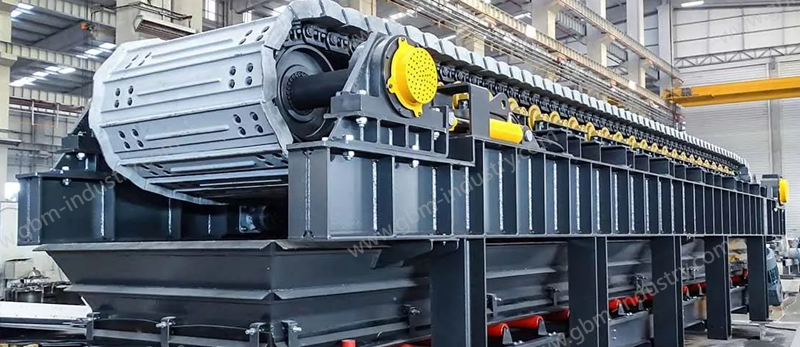
Heavy-duty belt conveyors also play a significant role in calcium carbide unloading and crushing systems, enhancing unloading efficiency and reducing manual intervention. Existing unloading methods typically require extensive manual labor and loader transport, whereas heavy-duty belt conveyors enable automated or semi-automated unloading. This reduces reliance on manual operations and loader transport, lowering labor intensity. This reduces labor costs, loader maintenance expenses, and fuel consumption while enhancing safety during unloading and transportation. Furthermore, the fixed unloading location created by heavy-duty belt conveyors facilitates the installation of dust collection systems, including hoods and ductwork. Under ideal conditions, this enables dust-free unloading, addressing environmental concerns.
Factors Affect Operation And Improvement Measure
(1) Power Unit (Main Shaft Drive Assembly)
The power unit, composed of components such as the motor, reducer, and coupling, primarily provides the operational power for the conveyor. The adequacy of the power supply and the reliability of its operation are key factors influencing the conveyor’s performance. The motor serves as the conveyor’s power source, typically selected with 1.2 times the required power rating. During concentrated calcium carbide unloading, overload shutdowns may occur due to momentary excessive material loading. Therefore, motor power selection should be 1.2 to 1.5 times the operational power requirement.
The primary function of the reducer is to amplify the motor’s torque. Heavy-duty plate conveyors typically employ worm gear reducers or cycloidal gear reducers capable of withstanding high torque. In practical applications, conveyors are often installed at a certain transport incline. When using cycloidal gear reducers, the “reverse running” phenomenon during equipment stoppage cannot be effectively suppressed, which can easily damage the cycloidal gear reducer during this process. To mitigate the damage caused by “reverse running,” backstops are installed, but their effectiveness in practice is often unsatisfactory. While worm gear reducers have lower efficiency, they inherently possess backstopping functionality, feature a simple structure, and have lower maintenance costs, making them suitable for heavy-duty plate conveyors.
(2) Chain Plates and Chains
During unloading, calcium carbide strikes the chain plates directly without any cushioning measures. The chain plates endure immense impact forces, leading to bending and deformation during prolonged operation. There are two methods to enhance the chain plates’ impact resistance: 1. Increase the thickness of the chain plates. Common chain plate thicknesses of 10–16 mm prove inadequate for long-term use. Increasing the thickness to 20 mm significantly improves deformation resistance. The drawback is that increased plate thickness adds weight, requiring a more powerful drive unit and reinforced support structures like the frame and idler rollers to accommodate the greater load. 2. Improve plate material by using higher-hardness, impact-resistant, and deformation-resistant materials (e.g., Mn13 or QT900). Regardless of the method chosen, increased production costs are inevitable.
The chain drives the plate forward, with each link enduring significant tensile stress. Beyond tensile deformation, pitch elongation due to wear is a primary cause of chain failure. Ensuring stable conveyor operation requires both high chain deformation resistance and durable chain pins. Common chain types include roller chains, sleeve chains, plate chains, and modular chains. To extend chain service life, most chains require lubrication at the pin joints. In heavy-duty plate conveyors operating in calcium carbide dust environments, dust accumulation on lubricated surfaces accelerates wear and reduces chain lifespan. Track chains for construction machinery are designed for maintenance-free operation in harsh conditions, though their long-term reliability requires extensive validation.
(3) Tail Wheel Assembly
Regardless of the chain type selected, wear at connection points and pitch elongation are inevitable. The primary function of the tail wheel assembly is to tension the chain, minimizing accidents such as misalignment and derailment caused by chain elongation due to wear. Most conveyors employ drum-type fixed tail wheels, utilizing two sets of lead screws to adjust chain tension.
Heavy-duty plate conveyors experience significant vibration from calcium carbide impacts during operation, rendering fixed tail wheels unsuitable for such conditions. To mitigate vibration effects, a combination of tension basket dampers and coil springs replaces the threaded rods. Chain tension is achieved by adjusting spring tension, while the hydraulic damper and coil spring combination provides effective buffering to reduce vibration impact on equipment.
GBM Delivers High-Efficiency Conveyors
Addressing the demanding operational stability requirements and harsh environments in calcium carbide unloading and crushing systems, GBM provides high-efficiency heavy-duty plate conveyors. Leveraging advanced design concepts and mature manufacturing processes, we deliver more reliable and durable conveying solutions for our customers. GBM equipment employs high-margin motors paired with worm gear reducers in its power unit configuration, effectively suppressing “reverse running” phenomena to ensure smooth and reliable equipment start-up and shutdown. Chain plates utilize high-strength wear-resistant materials (such as Mn13), with thickness optimized to exceed 20mm, significantly enhancing impact resistance and deformation tolerance to withstand heavy-load shock conditions during calcium carbide unloading. Additionally, the GBM conveyor incorporates a tensioning system combining a basket damper with a spiral spring, effectively absorbing operational vibrations to prevent chain deviation or derailment, ensuring long-term stable operation. The application of GBM heavy-duty plate conveyors not only elevates the automation level of unloading and crushing systems, reducing manual intervention and operational costs, but also facilitates targeted dust removal and environmental compliance. This empowers calcium carbide industry clients to achieve efficient, safe, and green production objectives.