

Gypsum is not the worst bulk material to handle—but it is close. It is moderately abrasive, moderately heavy, and often damp. That dampness makes it sticky. Gypsum clings to grab shells, builds up in corners, and refuses to drop out cleanly. A standard grab designed for coal or grain will soon be clogged, losing capacity and frustrating operators.
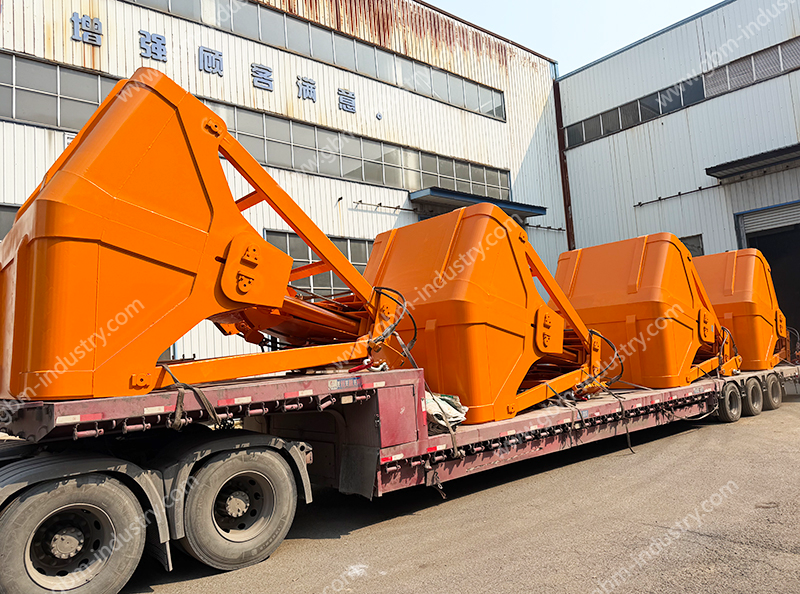
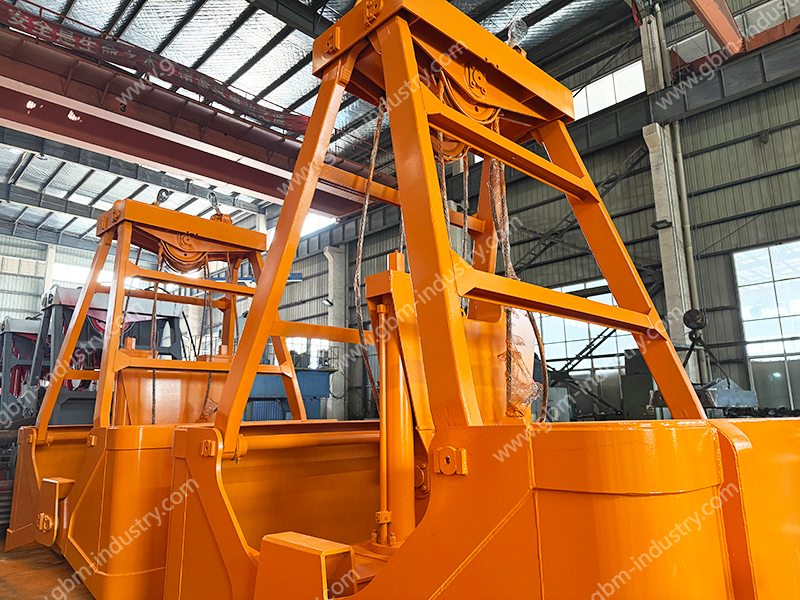
The gypsum is a key ingredient for cement production in the region for client; After discussing their operation with GBM, they ordered four custom remote control grabs, designed specifically for gypsum. We have now manufactured, tested, and shipped these four units.
What Makes Gypsum Tricky?
To design a grab that works well with gypsum, you first have to understand the material. Gypsum (calcium sulfate dihydrate) is mined or produced synthetically. It arrives at ports with moisture content that varies by source and season. Even a small amount of moisture makes the particles adhere to steel surfaces.
The sticking problem
When gypsum builds up inside a grab shell, two things happen. First, the effective volume decreases—a 6‑cubic‑meter grab might only hold 4 or 5 cubic meters before the operator sees that the shells won’t close fully. Second, the stuck material hardens over time, creating a permanent layer that reduces clearance and can even prevent the shells from seating properly. Operators then have to hammer or scrape the shells, a slow and unpleasant job.
Why standard grabs fail?
Ordinary grabs have internal ribs, sharp corners, and flat surfaces where damp gypsum finds a foothold. The more complex the interior shape, the more places for material to lodge. The Colombian customer’s previous grabs had exactly these issues. They needed a grab designed from the ground up to shed gypsum, not hold it.
Special Shell Shape That Mini Retention
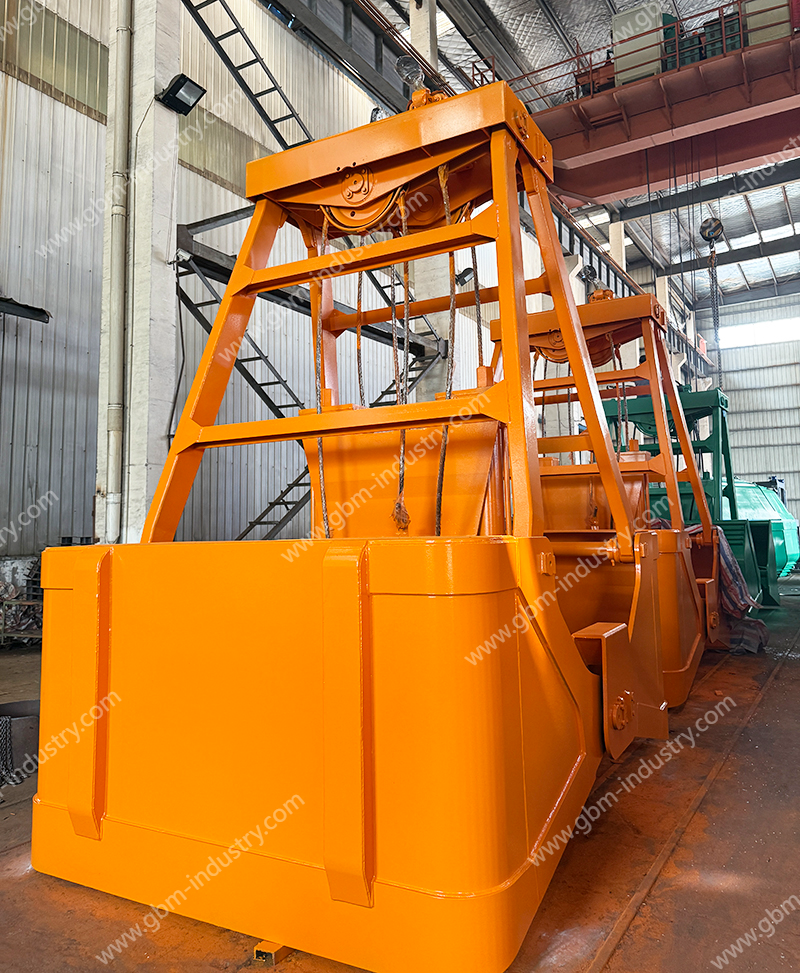
Our engineering team studied the problem and developed a custom shell geometry for these four grabs. The design focuses on eliminating internal ledges and creating smooth, continuous curves.
Smooth interior surfaces
The shells are fabricated with no internal stiffeners that would create pockets. Instead, the structural strength comes from the outer shape and carefully placed external ribs. The interior is as clean and continuous as possible—like the inside of a scoop, not a box. When gypsum enters, it has no place to lodge. The material flows out cleanly when the grab opens.
Optimized angle and radius
The curvature of each shell was calculated specifically for gypsum’s angle of repose and adhesion characteristics. The radius at the tip ensures that material does not compact in the hinge area. The leading edges are tapered to cut through a pile without pushing material sideways. The result is a grab that fills fully and empties completely, cycle after cycle.
Testing the design
Before manufacturing all four, GBM produced a prototype shell section and tested it with damp gypsum simulant. The material released almost entirely with a simple shake of the grab. The Colombian customer reviewed the test video and approved the design. They knew they were getting a tool built for their specific material, not a generic product.
Experience That Counts
The gypsum grabs for Colombia are not an isolated example. GBM has designed and built grabs for dozens of materials: coal, grain, fertiliser, clinker, pet coke, wood chips, scrap metal, and now gypsum. Each material has its own personality—abrasive, sticky, light, heavy, dusty, or corrosive. We have learned that a “one grab fits all” approach fails in the real world.
What customization means?
When a customer approaches us with a new material, we ask specific questions: What is the typical moisture range? Does it compact under pressure? Does it freeze? Is it hot? What is the particle size distribution? The answers drive our design choices: shell thickness, hinge placement, tip geometry, lining material (if any), and even the paint system.
Solve Real Problems
The shipment of four gypsum grabs to Colombia is another chapter in GBM’s story: we listen, we engineer, we deliver. Our factory is equipped to produce custom grabs in small or large batches, from 2 cubic meters to 20. We have in‑house design capabilities, structural analysis, hydraulic expertise, and a quality system that tests every grab before it leaves.
If your terminal handles a material that sticks, packs, or behaves unpredictably, talk to GBM. We will design a remote-control grab that fits your crane, your material, and your budget. Contact us today.
Let us show you what true customization looks like.