

Introduction
In heavy industry, port logistics, construction, and waterway engineering, efficient material handling is the core of project productivity. Among all mechanical handling attachments, the clamshell grab stands out as one of the most versatile, durable, and cost-effective solutions for grabbing, lifting, loading, and unloading bulk and loose materials. Shaped like a clam’s opening and closing shell, this industrial grab bucket relies on mechanical or hydraulic power to clamp materials tightly, enabling precise and high-capacity material transfer across diverse working scenarios.
Whether you are managing port cargo operations, river dredging projects, construction earthwork, or factory waste handling, a high-quality clamshell grab can drastically improve operational efficiency, reduce manual labor costs, and minimize material waste. This comprehensive guide will break down everything you need to know about clamshell grabs, including their working principle, core types, industrial applications, key advantages, operational tips, and professional selection criteria to help you choose the right equipment for your project needs.
What Is a Clamshell Grab?
A clamshell grab is a specialized mechanical attachment designed for cranes, excavators, and lifting equipment, consisting of two symmetrical shell-shaped buckets connected by a central hinge structure. Mimicking the opening and closing motion of a clam shell, the two bucket petals open to wrap around loose or bulk materials and close firmly to grip loads securely for lifting and transportation. After moving materials to the target position, the petals open again to release the load accurately.
Unlike traditional lifting hooks or fixed buckets, the clamshell grab features autonomous material grabbing and releasing functions without auxiliary manual operation. It is exclusively engineered for handling irregular bulk materials, including sand, soil, gravel, coal, grain, ore, silt, scrap metal, and construction waste. With a compact structural design and strong gripping force, it adapts to flat ground stockyards, narrow dock spaces, and complex underwater working environments, making it an indispensable core accessory for modern bulk material handling systems.
Working Principle of a Clamshell Grab
The entire working process of a clamshell grab follows the lever principle and pulley transmission mechanism, with stable mechanical transmission and reliable operation. Although mechanical and hydraulic models have different driving modes, their core working logic remains consistent, divided into four standard operation steps:
1. Descending and Opening
Driven by the supporting equipment (crane or excavator), the clamshell grab descends vertically to the surface of the material pile. At this stage, the grab’s two shell petals remain fully open to ensure maximum contact area with bulk materials and prepare for material wrapping.
2. Material Grabbing and Closing
After touching the material pile, the grab continues to descend slightly to allow materials to fully fill the gap between the two petals. Then the driving system (steel wire rope traction for mechanical types or hydraulic cylinder thrust for hydraulic types) acts on the pulley and lever structure, driving the two shell petals to close inward slowly. The gradual closing motion tightly wraps internal materials to avoid leakage.
3. Lifting and Transportation
Once fully closed, the grab forms a sealed bucket structure. The crane or excavator lifts the grab vertically. Relying on uniform internal stress and strong shell rigidity, the grab stably locks internal bulk materials without falling off during horizontal or vertical transportation.
4. Accurate Release
After reaching the designated unloading position, the control system releases the locking force. The shell petals open automatically under gravity or hydraulic reset, and all internal materials are completely discharged to finish a full working cycle.
For rope-controlled mechanical clamshell grabs, two sets of steel wire ropes work collaboratively: support ropes maintain overall balance and lifting stability, while opening-closing ropes control the petal switching action, ensuring synchronized and efficient operation.
Main Types of Clamshell Grabs
According to different driving modes and structural designs, clamshell grabs are mainly divided into mechanical clamshell grab and hydraulic clamshell grab. Each type has unique performance characteristics and applicable scenarios, which users need to distinguish clearly during selection.
1. Mechanical Clamshell Grab (Wire Rope Type)
The mechanical clamshell grab is the most traditional and widely used type, driven entirely by steel wire ropes and pulley blocks without any hydraulic components. It is further divided into two-rope and four-rope structures:
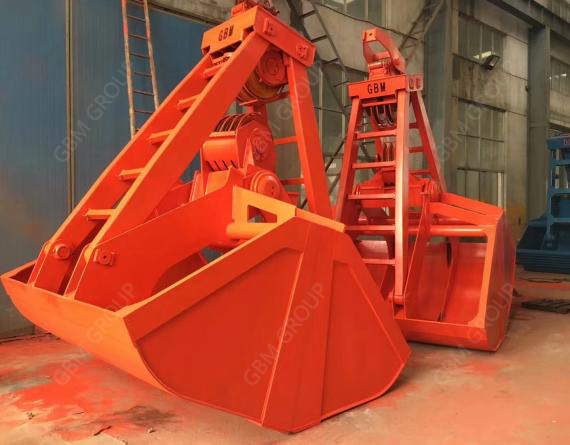
Two-rope clamshell grab features a simple structure, low cost, and easy maintenance, suitable for conventional light and medium bulk materials such as grain, coal, and dry sand. It is widely matched with ordinary portal cranes and overhead cranes for stockyard handling operations.
Four-rope clamshell grab optimizes the force-bearing structure with four sets of steel wire ropes, realizing uniform stress on the grab body, stronger gripping force, and more stable operation. It is not easy to deform under heavy loads and is suitable for high-frequency, heavy-duty working scenarios such as port bulk cargo loading and unloading, ore handling, and river dredging.
Core advantages: Simple structure, low failure rate, low manufacturing and maintenance costs, strong environmental adaptability, no risk of hydraulic oil leakage, and suitable for high-dust and humid working environments.
Limitations: Relatively low grabbing accuracy, manual auxiliary adjustment required for individual complex materials, and slightly lower efficiency than hydraulic models for continuous operation.
2. Hydraulic Clamshell Grab
The hydraulic clamshell grab takes the hydraulic cylinder as the core power component, relying on hydraulic pressure to drive the opening and closing of shell petals. It is mostly installed on excavators and hydraulic cranes, featuring intelligent and precise control. The hydraulic system can provide stable and powerful closing force, enabling the grab to tightly grip hard materials such as gravel, clay, and blasted rock.
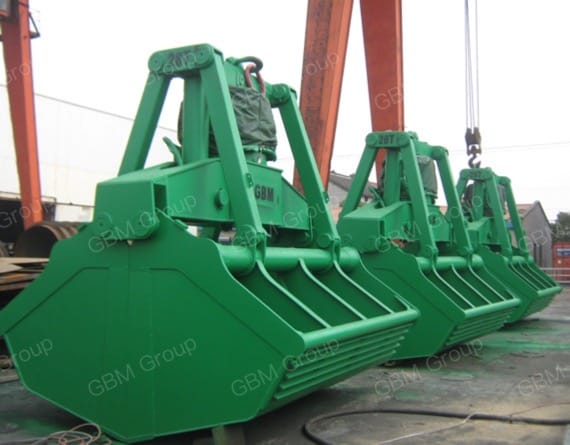
Core advantages: High grabbing accuracy, adjustable gripping force, fast response speed, high continuous operation efficiency, and strong adaptability to hard and wet materials. It can realize precise partial grabbing and avoid excessive material waste.
Limitations: Higher equipment cost, regular maintenance of hydraulic components required, and strict requirements for hydraulic oil quality to prevent leakage and component damage.
Key Industrial Applications of Clamshell Grab
Thanks to its strong versatility and high efficiency, the clamshell grab covers multiple industries and working scenarios, becoming a standard configuration for bulk material handling engineering:
1. Port and Terminal Cargo Handling
Ports and terminals are the most mainstream application scenarios for clamshell grabs. Four-rope mechanical clamshell grabs are widely used for loading and unloading bulk cargoes such as coal, ore, grain, cement, and sulfur in docks. They can quickly complete ship-to-shore material transfer and stockyard stacking operations, greatly improving port turnover efficiency and reducing cargo residence time.
2. River, Harbor and Waterway Dredging
The clamshell dredging grab is a special customized type suitable for underwater operation. Its shell petals are designed with wear-resistant teeth and high-sealing structures, which can effectively grab underwater silt, soft clay, sandy soil, and sunken gravel. It is widely used in river regulation, harbor depth improvement, waterway dredging, and underwater obstacle cleaning projects, playing a key role in improving waterway navigation capacity.
3. Construction and Earthwork Engineering
In construction sites, hydraulic clamshell grabs matched with excavators are used for earthwork excavation, sand and gravel handling, foundation pit cleaning, and construction waste sorting and transportation. Their flexible operation adapts to narrow construction spaces and complex terrain conditions, replacing inefficient manual handling and accelerating project progress.
4. Factory and Logistics Stockyard Operation
Steel plants, power plants, and chemical plants often use two-rope mechanical clamshell grabs for daily handling of raw materials such as coal powder, mineral powder, and industrial raw materials. In logistics stockyards, the grab realizes rapid stacking and transfer of bulk materials, optimizing stock space utilization and improving overall logistics efficiency.
5. Waste Recycling and Environmental Protection Engineering
Clamshell grabs are also commonly used in garbage transfer stations and environmental protection projects for grabbing and sorting loose domestic waste, construction waste, and scrap metal. Their strong gripping force can handle irregular waste materials, realizing mechanized waste sorting and reducing secondary pollution caused by manual operation.
Core Advantages of Using a Clamshell Grab
Compared with other material handling equipment such as fixed buckets and gripper buckets, the clamshell grab has irreplaceable comprehensive advantages in industrial operation:
1. Ultra-high operational efficiency: The integrated grabbing, lifting, and releasing working mode realizes one-stop material handling, with a short single operation cycle and high-frequency continuous working capacity, effectively improving overall project efficiency.
2. Strong material adaptability: It can handle almost all loose and bulk materials, including dry materials (grain, coal), wet materials (silt, clay), and hard granular materials (gravel, ore). Tooth-shaped shell designs can cope with hard and irregular materials.
3. Excellent stability and safety: The symmetrical shell structure and uniform force-bearing design ensure no material leakage during lifting. The mechanical locking structure effectively prevents accidental opening, reducing operational safety risks.
4. Low operating cost: Mechanical clamshell grabs have a simple structure, few vulnerable parts, and low daily maintenance costs. The mechanized operation greatly reduces labor investment and long-term operating costs.
5. Wide equipment compatibility: It can be matched with various conventional equipment such as portal cranes, overhead cranes, ship unloaders, and excavators without complex modification, featuring strong versatility.
Professional Clamshell Grab Selection Guide
To maximize equipment utilization, users need to select a suitable clamshell grab based on actual working conditions. Here are the core selection criteria:
1. Select driving mode based on working scenario: For conventional dry bulk material handling in ports and stockyards with low precision requirements, choose a cost-effective mechanical wire rope clamshell grab. For underwater dredging, hard material handling, and high-precision operation scenarios, prioritize a hydraulic clamshell grab with stable power and high accuracy.
2. Confirm load capacity and volume specification: Select the grab’s volume (common specifications: 5cbm, 10cbm, 12cbm, 24cbm) and load-bearing capacity according to the supporting crane’s lifting tonnage and daily material handling volume to avoid overload operation or insufficient efficiency.
3. Match shell structure with materials: Use flat toothless shells for soft materials such as silt and mud to improve sealing performance. Choose tooth-shaped shells with strong gripping force for hard materials such as gravel and ore to prevent material slipping.
4. Focus on material and wear resistance: High-quality clamshell grabs are made of high-strength wear-resistant steel, which can resist long-term friction and impact of materials. For high-frequency heavy-duty operation, prioritize products with anti-corrosion and wear-resistant treatments to extend service life.
Daily Maintenance and Operational Notes
Standardized maintenance can effectively extend the service life of clamshell grabs and reduce failure rates. Daily maintenance focuses on the following points:
First, regularly check the steel wire ropes, pulleys, and hinge parts of mechanical grabs for wear, deformation, and loosening, and lubricate movable parts regularly to ensure flexible transmission. Second, for hydraulic clamshell grabs, replace hydraulic oil regularly, check oil pipe seals for leakage, and keep the hydraulic system clean. Third, clean residual materials on the shell surface after daily operation to avoid long-term corrosion and abrasion. Fourth, avoid overload operation and violent collision during use to prevent structural deformation and performance damage.
Conclusion
As a mature and efficient industrial handling accessory, the clamshell grab has become an essential equipment for bulk material handling in ports, construction, dredging, and environmental protection industries. With its simple and reliable working principle, diverse types, strong versatility, and cost-saving advantages, it continues to help major industries improve operational efficiency and reduce production costs.
Whether you need a low-cost mechanical clamshell grab for conventional stockyard operation or a high-precision hydraulic clamshell grab for complex dredging and hard material handling, clarifying your working scenario, material characteristics, and equipment matching requirements is the key to selecting the most suitable product. With correct selection and standardized maintenance, the clamshell grab can maintain stable high-efficiency operation for a long time, creating greater economic value for engineering projects.