

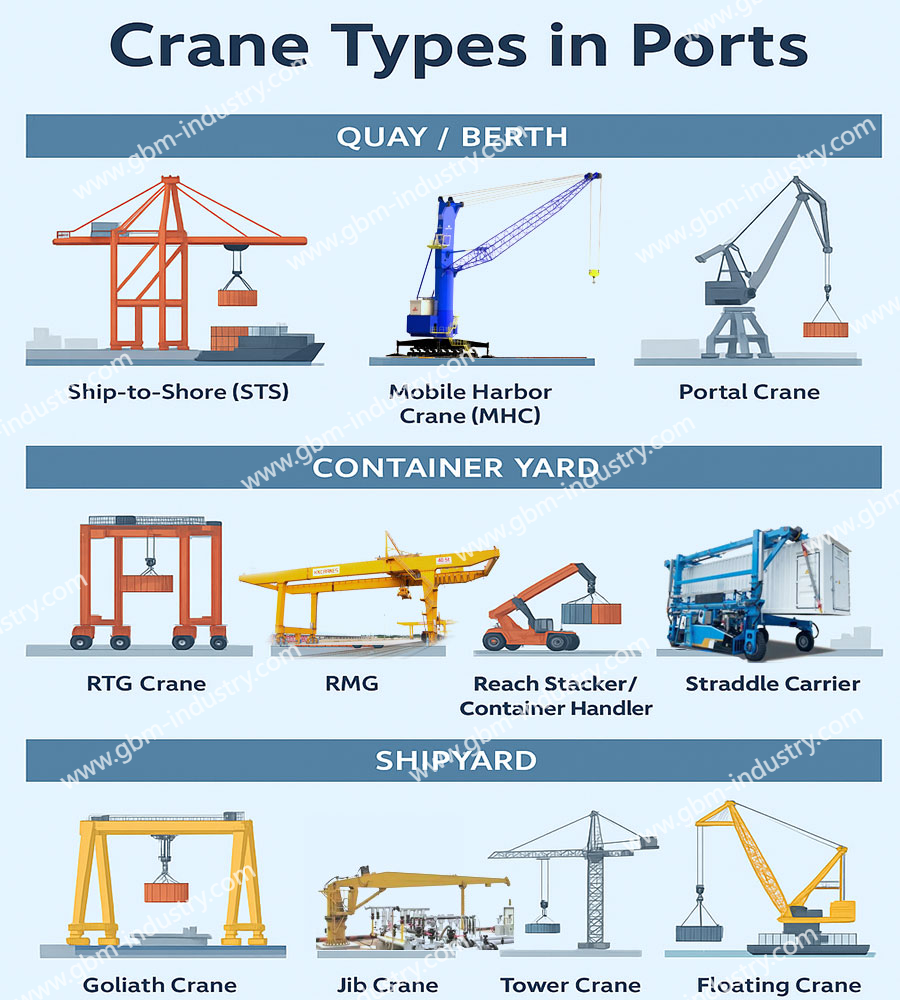
With the rapid growth of container transportation both domestically and internationally, various new container yard processes and equipment continue to emerge. Traditional yard machinery is also undergoing continuous improvements, with several new technologies being applied. Current container yard equipment primarily includes rubber-tired gantry cranes (RTGs), rail-mounted gantry cranes (RMG), overhead container cranes, reach stackers, straddle carriers, and container forklifts. Among these, the first three crane types offer superior efficiency and space utilization in container yards.
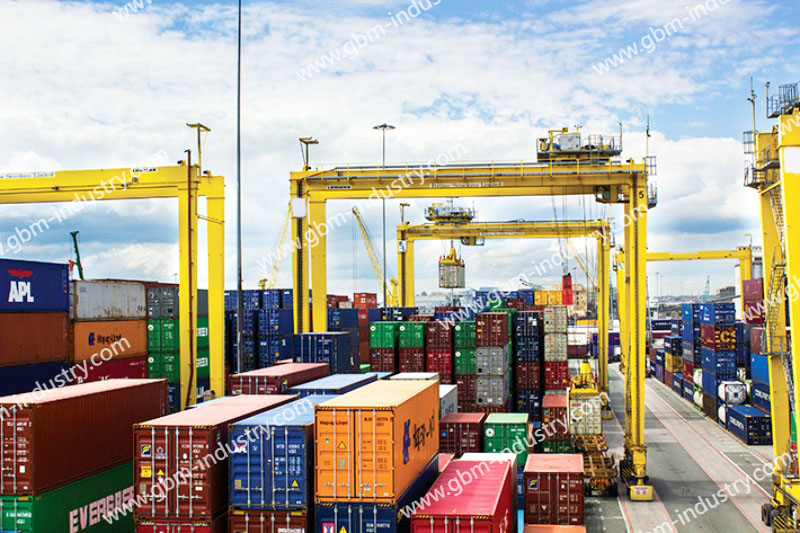
Rubber-Tired Container Gantry Crane
The rubber-tired container gantry crane is currently the primary equipment type in container yards. In recent years, extensive research has been conducted globally on traditional RTGs, with continuous advancements in technology and innovation. These developments primarily address the shortcomings of conventional RTGs, such as:
– Rising international fuel prices leading to excessive operational costs
– Environmental pollution caused by diesel exhaust emissions and noise
– Low automation levels, complex maintenance requirements
– High tire pressure
Key Technical Performance
Among currently operational RTGs, the lifting height is predominantly set at “stack five, pass six.” However, in orders placed during 2005 and 2006, RTGs capable of “stack six, pass seven” and higher configurations are increasingly prevalent. Of the 679 units delivered in 2005, over 248 units featured this capability. Conversely, RTGs configured for “stack four, pass five” accounted for only about 5% of orders placed in 2006. Span is another critical performance parameter. Currently, the vast majority of RTGs feature a span of 6+1, approximately 23.5 meters. However, RTGs with spans of 7+1 or greater accounted for over 24% of orders in 2005. The largest span currently available reaches 14+1.
Electric RTGs
The primary motivation for retrofitting existing RTGs or building new ones with electric power is to address shortcomings such as high fuel costs and significant environmental pollution.
Electric RTGs primarily employ two power supply methods: cable reel power supply with either low-voltage (380V) or high-voltage (6kV or 10kV) connections, similar to existing RMG systems; or conductor rail power supply, analogous to urban trolleybus systems. Due to limited space on RTGs for installing high-voltage switchgear, low-voltage power supply remains predominant for electric RTGs.
The ability to relocate between sites is a key advantage traditional diesel-powered RTGs hold over RMG. However, after adopting electric drive, RTGs face relocation challenges regardless of the power supply method. Three solutions exist: (1) Eliminate relocation, confining RTGs to fixed sites like RMG; (2) Retain original diesel generators in retrofitted RTGs, switching to diesel power during relocation; (3) Equip newly developed RTGs with compact diesel generators dedicated to relocation.
The greatest advantage of RTGs lies in their flexible relocation capability. Eliminating this maneuverability would diminish their competitive edge over RMG to some extent. Consequently, some propose that electric conversion technology for RTGs should focus on retrofitting existing units rather than developing new models.
Four-Drum Lightweight RTG
Its hoisting mechanism and trolley travel mechanism share a single drive system. This drive system comprises four independent or paired drum systems (referred to as 4-drum) located on the lower crossbeams of the RTG’s side door frames. Through the sequential or simultaneous operation of these four drums, it achieves both load lifting and trolley travel functions, as well as coordinated lifting and travel operations. Unlike traditional RTGs, this crane’s hoist trolley lacks separate hoisting and trolley travel mechanisms. This drive configuration maximizes reduction of trolley self-weight, resulting in an overall machine weight approximately half that of conventional RTGs. With extremely low wheel load (only 20 tons), it achieves full-machine lightweighting, reducing equipment and site foundation investment. This makes it highly suitable for numerous small and medium-sized ports and container transshipment terminals.
Eco-Friendly RTGs
To address high fuel consumption and pollution, numerous energy-saving and environmental upgrades have been explored globally in recent years. Key technologies include supercapacitor energy storage and regenerative drive systems. These operate by temporarily storing energy generated during load descent and trolley braking, then releasing it back into the system during load lifting and trolley acceleration. Some research outcomes have been implemented with positive results.
Rail-Mounted Gantry Cranes
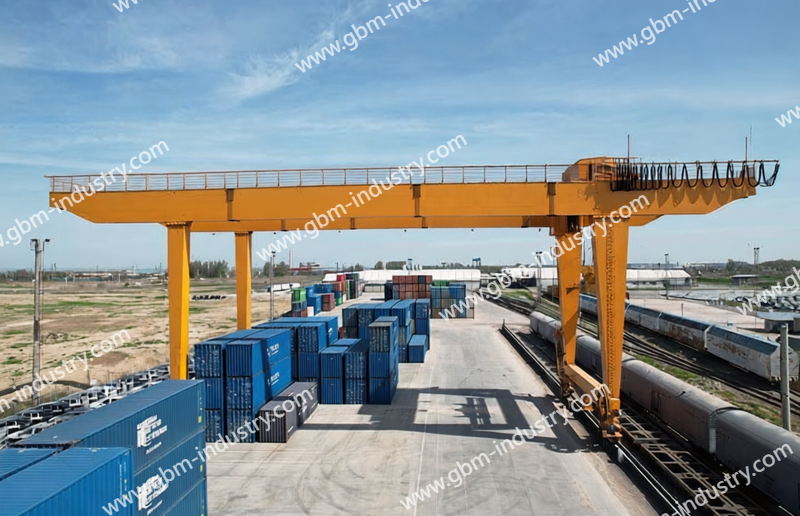
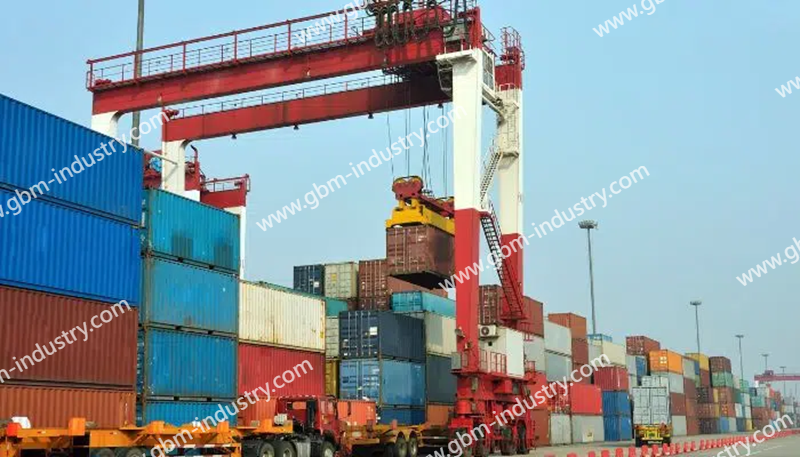
Early RMGs were primarily used in railway container yards and inland river container terminals, with performance parameters lower than RTGs. In recent years, addressing RTG shortcomings such as high fuel costs, diesel exhaust and noise pollution, and low automation levels, the development and application of RMGs have increased globally. They have been widely adopted in container terminals at many large and medium-sized coastal ports. Currently, at least ten domestic manufacturers (including those within the railway system) produce RMG cranes, far exceeding the number of RTG manufacturers.
Longer Spans and Multi-Purpose Capabilities
The rapid growth of container transportation has spurred the development of small and medium-sized ports, inland river ports, and privately funded ports. Constrained by geographical conditions, funding, technology, and management capabilities, these ports seek equipment that is cost-effective, energy-efficient, easy to maintain,
Large-span RMG units are often equipped with hook beams to handle long, oversized cargo and general cargo. Some RMG units, beyond container yard operations, can utilize cantilevers for ship loading/unloading or span harbor basins for vessel operations, achieving multi-functional use.
Due to the relatively lower static and dynamic stiffness of long-span RMG (span exceeding 35m) compared to shorter-span RMG and RTG, the crane’s speed parameters are generally lower, resulting in reduced operational efficiency.
Elevated Container Gantry Cranes
To further enhance crane operating speeds and thereby improve operational efficiency, Singapore Port has adopted elevated container gantry cranes. These cranes traverse rail beams supported by 15-meter-high bridge columns, with control systems fully automated to enable driverless operation. Without gantry legs, these cranes feature a low center of gravity, delivering significantly superior stability, wind resistance, slip resistance, and structural rigidity compared to RTGs and RMGs. Their lighter structural weight also reduces acceleration time, enabling faster crane travel speeds—up to 250 m/min and even exceeding 300 m/min.
Technology In Container Cranes
Dual-Lift Spreader
Currently, most RTGs and RMGs worldwide have a lifting capacity of 40 tons, capable of handling only one 20-foot or 40-foot container at a time. However, shore-based container cranes at terminal frontlines increasingly adopt dual-lift configurations, creating a mismatch between front and rear operations that severely hampers improvements in loading/unloading and yard efficiency. ZPMC developed a 60-ton dual-container RTG in 2002 capable of lifting two 20-foot containers simultaneously. After two years of testing, it demonstrated excellent performance.
Fully Electric Spreader
Currently, nearly all container cranes utilize hydraulic specialized spreaders. In recent years, fully electric container spreaders have gained prominence, with new products emerging successively. The adoption of fully electric spreaders could enable yard cranes to completely eliminate hydraulic systems, thereby reducing crane weight and saving equipment investment and operational costs. Statistics indicate that equipping the same RTG with electric spreaders instead of hydraulic spreaders can achieve a 10% fuel savings.
Innovation of Specialized Lifting Appliances
Technological advancements in container yard cranes are inseparable from the synchronized innovation of their related lifting appliance systems. As a specialized container lifting appliance supplier, GBM remains committed to providing safe, efficient, and intelligent lifting appliance solutions for all types of yard cranes (including RTGs, RMGs, and overhead gantry cranes), precisely meeting the latest industry development demands.
Regarding safety, GBM spreaders utilize high-strength materials and redundant designs, incorporating multiple safety interlocks and real-time status monitoring systems to ensure intrinsic safety during handling operations under all conditions. Their products seamlessly adapt to the power drive characteristics of electric RTGs and energy-efficient RTGs, enabling precise and smooth electric control to prevent impact while supporting synergistic operation with energy recovery systems.
For efficiency gains, GBM’s dual-box spreader technology effectively resolves the bottleneck of mismatched front-to-back terminal operations. This enables a single RTG or RMG to lift two 20-foot containers simultaneously, significantly boosting yard turnaround and loading/unloading efficiency. Simultaneously, its spreader design fully accounts for the rigidity characteristics of long-span RMGs and the high-speed operational demands of overhead cranes. Through lightweight construction and optimized dynamic design, it ensures rapid response and stable operation under high-speed, long-span working conditions.
For more details,please contact GBM for free consultation:sales.export@gbm-china.com